Journey through the Ancient Agora, the birthplace of democracy, where temples and stoas echo the debates and decisions that shaped Western history. With an optional multilingual audio guide, uncover the stories of philosophers, statesmen, and everyday Athenians as you walk the same paths where Socrates, Pericles, and Aristides once stood.
Meet your host just outside the entrance to the archaeological site, located near the Monastiraki metro station, a vibrant hub that makes it easy to spot. After a quick ticket validation, you’ll receive orientation on using your audio guide (if selected), complete with offline access and an interactive map to navigate the site at your own pace. From here, you’re free to explore one of Athens’ most iconic landmarks with history in your pocket.
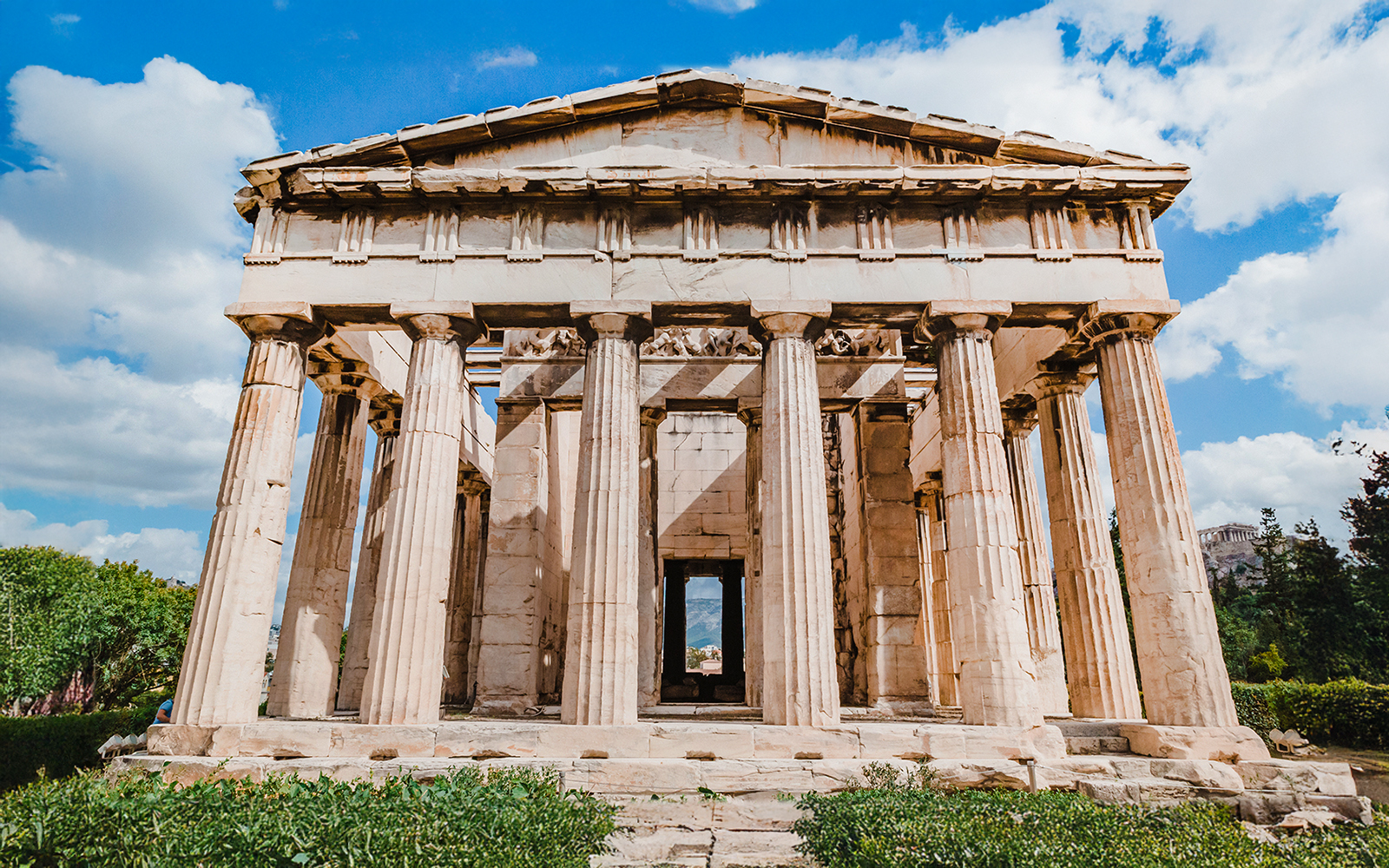
Begin your journey at the Temple of Hephaestus, the best-preserved Doric temple in Greece. Nestled on a hill overlooking the Agora, its elegant columns and friezes honor the god of craftsmanship, a fitting tribute in a city celebrated for innovation. Just below lies the Bouleuterion, the council house where 500 citizens met daily to draft laws. Imagine the lively debates that prepared motions for the Assembly, a cornerstone of the world’s first democracy.
Stroll into the grand Stoa of Attalos, a reconstructed colonnade that today houses the Museum of the Ancient Agora. Inside, artifacts reveal both the ingenuity and strictness of Athenian society, from ostraka (shards used in exile votes) to jury selection machines that ensured fairness in trials. Your audio guide breathes life into these relics, explaining how justice was practiced in ways both radical and ruthless, while anecdotes about figures like Aristides the Just showcase democracy’s very human dimension.
Climb the hill of the Pnyx, a rocky platform with sweeping views of the Acropolis. This was the stage of democracy itself, where citizens gathered to vote, cheer, or jeer as leaders like Pericles addressed the crowd. With audio commentary, you can picture the assembly of thousands debating war, peace, and policy, while the panoramic view gives you the same perspective Athenians once had as they shaped history. Nearby, the Rock of Ares (Areopagus) adds another chapter, renowned as the site where Ares himself was tried by the gods.
As your path winds toward Philopappos Hill, you’ll come across the Prison of Socrates, said to be where the philosopher spent his final days before drinking hemlock. Whether fact or myth, it sparks reflection on how Athens both nurtured and silenced its thinkers. Along the way, your guide shares stories of Solon’s legal reforms and the cultural flowering under Pericles, making the Agora a living classroom of human ambition and ideals.
Your tour concludes near the Theatre of Dionysus, just outside the Agora and at the foot of the Acropolis. Here, the tragedies of Aeschylus, Sophocles, and Euripides were performed for the first time, shaping theatre as we know it today. It’s a fitting finale, tying together politics, philosophy, and performance in the city that gave the world democracy, drama, and enduring ideas.
| Inclusions | Exclusions |
|---|---|
|
|
Wear comfortable, sturdy shoes, as the ground can be uneven, dusty, and slippery during the dry months.
Carry a reusable water bottle; there’s a refill station by the Stoa of Attalos, especially handy in summer.
Pack essentials like a hat, sunscreen, and extra water since shaded areas around the ruins are limited.
Keep your phone fully charged so it lasts for the audio guide.
Bring your own headphones for a smooth listening experience.
Flash photography and tripods are prohibited inside. Professional filming or photography requires prior approval from the Ministry, and staff may intervene if you attempt to set up equipment without a permit.
Flying drones is forbidden without official authorization, so please don’t attempt to use one here.
Pets are not permitted on-site, though certified service animals are welcome.
Do not touch or remove stones, pottery shards, or any remains—these are protected under Greek law.
A wheelchair-accessible entrance is available at Apostolou Pavlou, near the Temple of Hephaestus, though inside the site, much of the terrain is uneven with gravel, slopes, and steps, making full access limited.
If entering from Adrianou 24, consider having a companion assist with navigating the rough ground. Site staff can also be contacted at +30 210 3214824 or +30 210 3210180.
The Stoa of Attalos Museum is fully accessible, with adapted restrooms.
At the information desk, tactile maps and brochures in Braille (Greek and English) are provided.
Due to ongoing construction works, the main entrance of the Ancient Agora is temporarily closed. Please use the temporary entrance on Apostolou Pavlou Street, near Akamantos Street.
Entry is only permitted within your reserved time slot (15 minutes before until 15 minutes after).
Arrive about 30 minutes early to allow for security checks; the last entry is 20 minutes before closing.
Your e-ticket and audio guide instructions will be sent in a separate email—check your spam folder. Download both to your device for offline use or print the ticket for entry.
The audio guide is not compatible with Windows Phones, iPhone 5/5C or earlier, iPod Touch 5th gen or earlier, iPad 4th gen or earlier, or the first iPad Mini.
Opening hours vary seasonally from 8am to 8pm (April to June) and gradually shorten to 8am to 5:30pm (late October), with last entry always 20 minutes before closing.
If you arrive between 8am and 9am, head straight up to the Temple of Hephaestus while it is still quiet, then follow the Panathenaic Way back down to the Stoa of Attalos Museum later in the day, when the shade makes it more comfortable.
EU citizens under 25, including students, enjoy free admission year-round with a valid ID or passport, but must queue at the ticket office to collect a zero-value pass.
Non-EU citizens under 25 are entitled to discounted rates during the peak season (April to October) with a valid ID, and must also queue at the ticket office.
Children under 5 years old enter free of charge.
EU citizens over 65 qualify for discounted rates.
Non-EU citizens over 65 qualify for discounted rates during the peak season (April to October).
Persons with disabilities (67% or more) and one accompanying person are granted free admission with a Disability Card, ID, or passport.
This activity is non-refundable and cannot be cancelled. Variant-specific cancellation policies may apply.