
How AllEvents helped Bhajman Beats Sold Out a Bhajan Night in Party-Capital Goa

Picture a Saturday night in Goa. You are probably imagining a beach club, a DJ who peaks at midnight, and a bar with no interest in closing. Now picture the exact opposite. A room where the crowd came to sing bhajans, phones mostly down, not a cocktail in sight, everyone locked into a devotional song that has been sung for centuries.
That room existed on 18 July 2026. And it sold out.
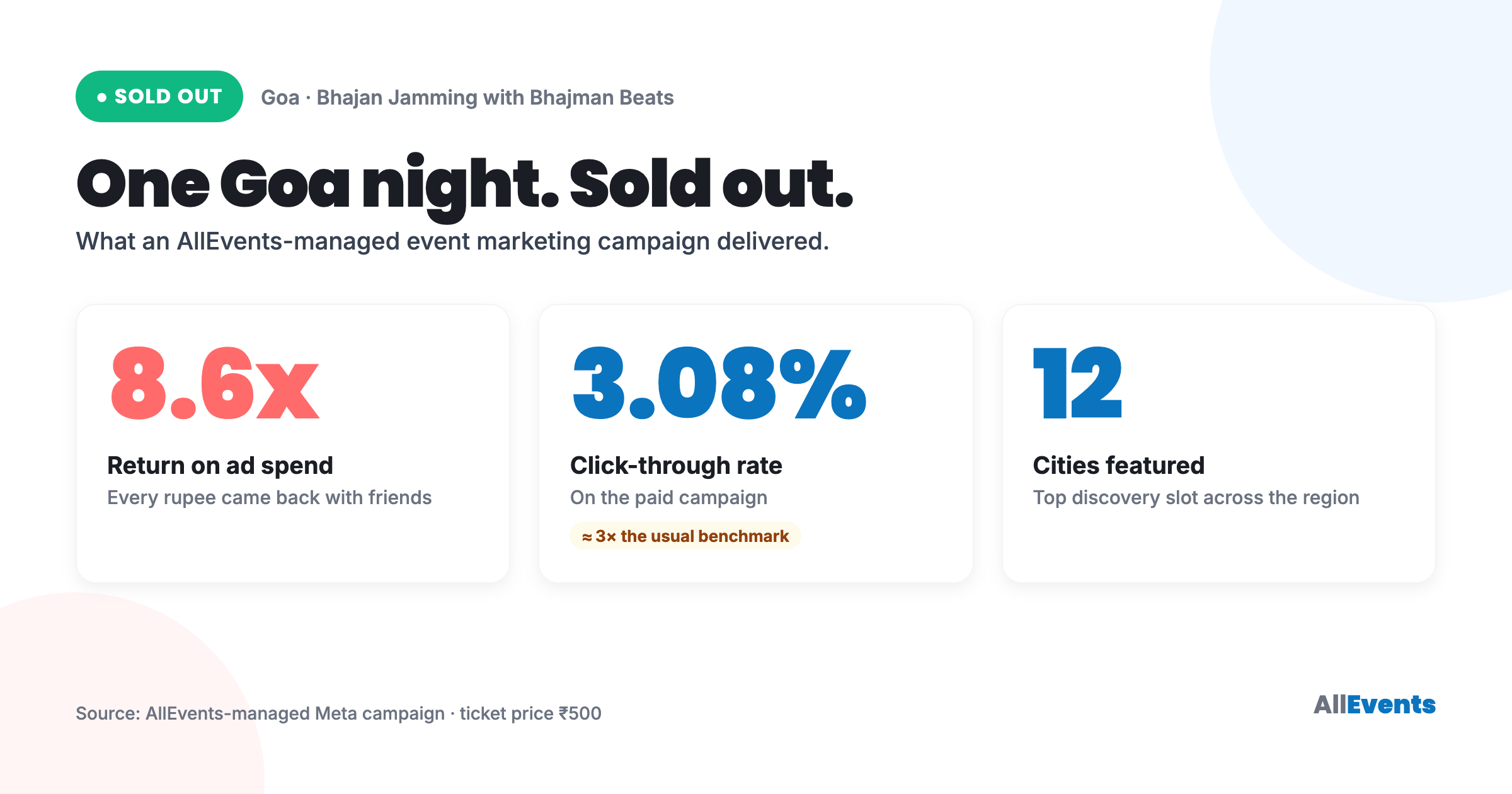
Bhajan jamming is one of India’s fastest-growing live formats, and Bhajman Beats brought it to Goa, the one city built on the opposite kind of Saturday night. The devotional show sold out in roughly 10 days, at an 8.6x return on ad spend and a 3.08% click-through rate, featured across 12 nearby cities. The hard part was never the format. It was finding the right crowd in the least obvious city. Here is how the event marketing did it.
The format that is outselling nightclubs
If bhajan jamming does not ring a bell yet, it will. Across India, devotional songs are being reimagined as live jam sessions with proper concert production, and a generation raised on club nights is showing up for them instead. Reporting from The Week and CNN has tracked the same thing: rooms in Mumbai, Delhi, and Bengaluru filling up for bhajan nights faster than for a lot of commercial concerts.
Bhajman Beats is part of that wave. For this show, they took it to Goa, a city far better known for the opposite kind of night.
Meet Bhajman Beats
Bhajman Beats stages bhajan-jamming nights for a live crowd, and they have been doing it for a while. Goa was one of several shows they have run, and not the first that AllEvents has marketed for them. That history shaped the brief. The job was never to explain the format or introduce a new act. It was to carry a show that already works into a city that had every reason to overlook it.
They brought the show and the date. The open question was the room.
The challenge: a devotional night in a party city
What made this hard is not what you would guess. The challenge was never whether people understand the format. The format is having a moment. The challenge was the address.
Goa is the one Indian city whose entire brand is the other kind of Saturday night: beaches, EDM, sunset raves, and a nightlife economy built on the opposite of a quiet devotional room. So the real question was narrow and awkward. In a city everyone associates with parties, can you find the few hundred people who want to spend their Saturday singing bhajans instead, and reach them before the night arrives?
A great show at a friendly ₹500 does not solve that on its own. The show was ready. The audience had to be found, in the least obvious place to look.
What AllEvents did
We ran the event marketing end to end: featured discovery across the region, plus a managed Meta ad campaign aimed at exactly the right crowd, all pointed at a one-tap checkout. The organiser did not touch an ad manager.
Find the right crowd in the “wrong” city
This was the whole game. The instinct in a party city is to chase the party crowd. That would have been the fast way to burn a budget. Instead, the targeting went after the audience the movement actually attracts: people seeking a spiritual, live-music experience, the same intent driving bhajan nights everywhere else, who just happened to be in and around Goa. Right format, right people, unlikely place. Get that match wrong and no amount of spend saves you.
Warm the region before you spend a rupee
Cold audiences are expensive. Warm ones are not. Before the ad budget did anything, the event took a top featured slot across 12 cities spanning Goa, Karnataka, and Maharashtra, so it kept surfacing for people across the region already browsing for something to do in Goa. That placement earned its own organic pull too, through shares and search, on top of the paid reach. By the time the paid ads arrived, they were nudging people who had half-seen the name rather than cold-pitching strangers. Discovery first, dollars second. The order is most of the trick.
Let the campaign learn, then let it run
The first few days of any campaign are for learning, and learning looks quiet. Early on, the budget stays measured while the system works out who actually buys rather than who merely taps “interested.” Once the buyers reveal themselves, the spend leans into them and scales into event week. It is unglamorous, and it is where most self-run campaigns quietly go wrong, because the temptation is to panic on day two and change everything. Holding nerve is a skill.
Make people want to click
A 3.08% click-through rate does not happen because the poster was pretty. It happens because several Meta (Facebook and Instagram) ad angles get tested, the weak ones get cut without sentiment, and the winner gets room to breathe. Three times the usual click rate means the message found the right people and gave them a reason to tap.
Guard the path to the ticket
The fastest way to lose a buyer is to make them work. Discovery, event page, checkout, in as few taps as anyone will tolerate. Every extra field, every stray redirect, every “create an account first” is a small leak, and small leaks sink sellouts. The campaign pointed straight at a clean, one-tap ticket checkout, so the intent the ads created did not evaporate on the way to the ticket.
The results
Start with the outcome. The night sold out, and it sold out in roughly 10 days. The paid campaign returned 8.6x on ad spend, the polite way of saying every rupee of budget came back with friends. And the ads pulled a 3.08% click-through rate, close to three times the rate most event campaigns settle for. In a city built to sell a different Saturday, that is not luck. It is the residue of a lot of small, deliberate decisions.
The sell-out curve
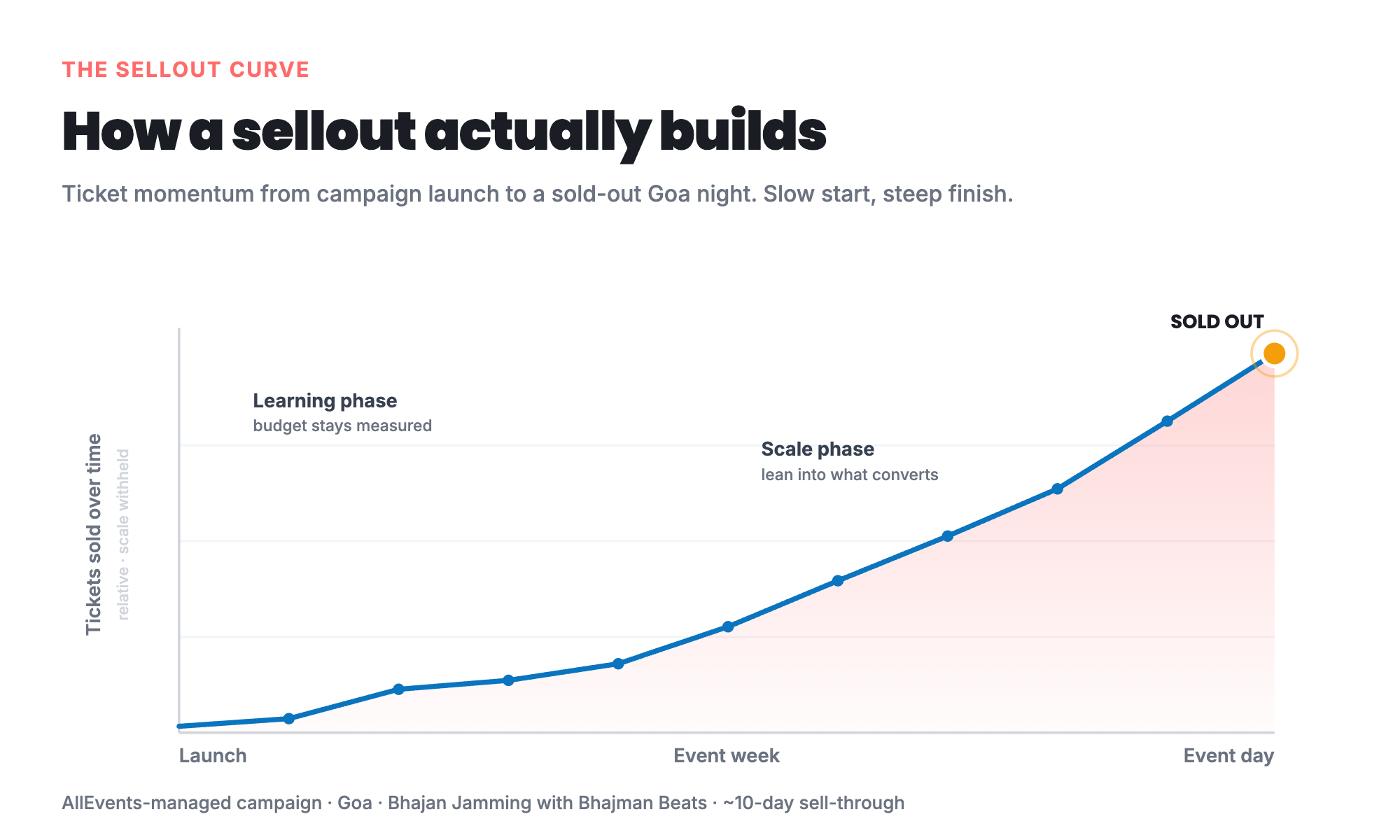
Ticket sales almost never arrive in a straight line. They open quietly, drift for a while, and then surge as the date gets real. Judge a campaign on its first day and you will kill the thing right before it works.
The Goa run followed that exact shape: a soft, patient start while the campaign learned, then a steep climb into the final stretch, ending at sold out. Nearly the whole story sits in the last few days. That is normal, and it is why the trend line matters more than any single day.
What a growing organiser can borrow
You do not need us to run your event to take the pattern. Here it is.
- Ride the wave, but aim itA rising format gets you attention. Matching it to the right audience, especially in an unlikely market, gets you a sellout.
- Discovery before dollarsGet seen by warm, nearby audiences before you pay to reach cold ones. Your cost per ticket will thank you.
- Judge the trend lineA quiet opening is normal. Watch how sales accelerate across the whole run, and do not overreact to a slow first day.
- Protect the checkoutA clean, one-tap path beats a clever ad with a clunky form behind it, every single time.
- Measure return, not applauseReach feels nice. Return on ad spend pays the venue.
None of this is exotic. It is done consistently, by people watching the numbers so the organiser can watch the show. That consistency is most of the job, and it is what turns a good event into a sold-out one.
Goa has a default Saturday night. Now it has two.
The city sells one kind of Saturday almost automatically: loud, late, and by the beach. Bhajman Beats proved there is a real appetite for the other kind, the quiet, communal, devotional kind, even here. The show was always theirs. They handed over a concept and a date; the discovery, the ads, and the straight line to the ticket were ours. The full room was a choice about how to market it, and who to look for.
If you want to see how the same approach plays out elsewhere, here is another partnership story worth a read.
Bring the show. We will help you find the crowd.
AllEvents runs event marketing the same way we ran this one: featured discovery, a Meta ad campaign tuned by hand, and a straight line to the ticket, wherever your audience is hiding.
Explore AllEvents event marketingFrequently asked questions
What is bhajan jamming?
Bhajan jamming, also called bhajan clubbing, is a live format where traditional devotional songs are reimagined as a jam session with full concert production. It has become one of India’s fastest-growing live events, drawing crowds that might once have gone to a nightclub.
Can a niche or devotional event sell out in a party city like Goa?
Yes. This Goa bhajan night sold out in roughly 10 days. The key was targeting the audience the format actually attracts, people after a spiritual live-music experience, rather than the general party crowd.
Do Meta ads work for live events?
Yes, when they are set up for purchases and given time to learn. This campaign returned 8.6x on ad spend at a 3.08% click-through rate, close to three times the usual benchmark.
How does a featured listing help ticket sales?
It puts your event in front of people already browsing for plans in your city, so paid ads land on a warm audience instead of cold strangers. Warm audiences convert at a lower cost per ticket.
How does AllEvents market an event?
AllEvents runs event marketing end to end: featured discovery across nearby cities, a managed Meta ad campaign tuned by hand, and a one-tap path to the ticket.

Written by
Paras Makhija
Making the world happening place to live by curating the best experiences.
View all posts