
How Backstage Siblings Introduced Nagpur to India's Bhajan Jamming Movement

Concerts, comedy nights, big live experiences. When people picture them, the same handful of cities usually comes to mind first, and Nagpur is rarely on that list. That quiet assumption is exactly why bringing Backstage Siblings to the city felt both thrilling and uncertain.
The story started nearly six months before anyone took the stage, when LWH, a long-time AllEvents partner, brought the idea to us. Backstage Siblings had built a loyal following for their soothing bhajan jamming nights, AllEvents had the reach and the ticketing engine to put the idea in front of a whole city, and the question was simple: could something like this work in Nagpur?
There were plenty of reasons to be skeptical. The city had never hosted a bhajan jamming event at this scale. The common belief was that experiences like these belonged to metro audiences, and that filling a large venue for something brand new would be a stretch. That is the thing about firsts, though. Before anyone buys a ticket, they have to believe the event belongs in their city. So the work ahead was never just about selling tickets. It was about introducing a new experience to Nagpur and building enough genuine excitement that people wanted in.
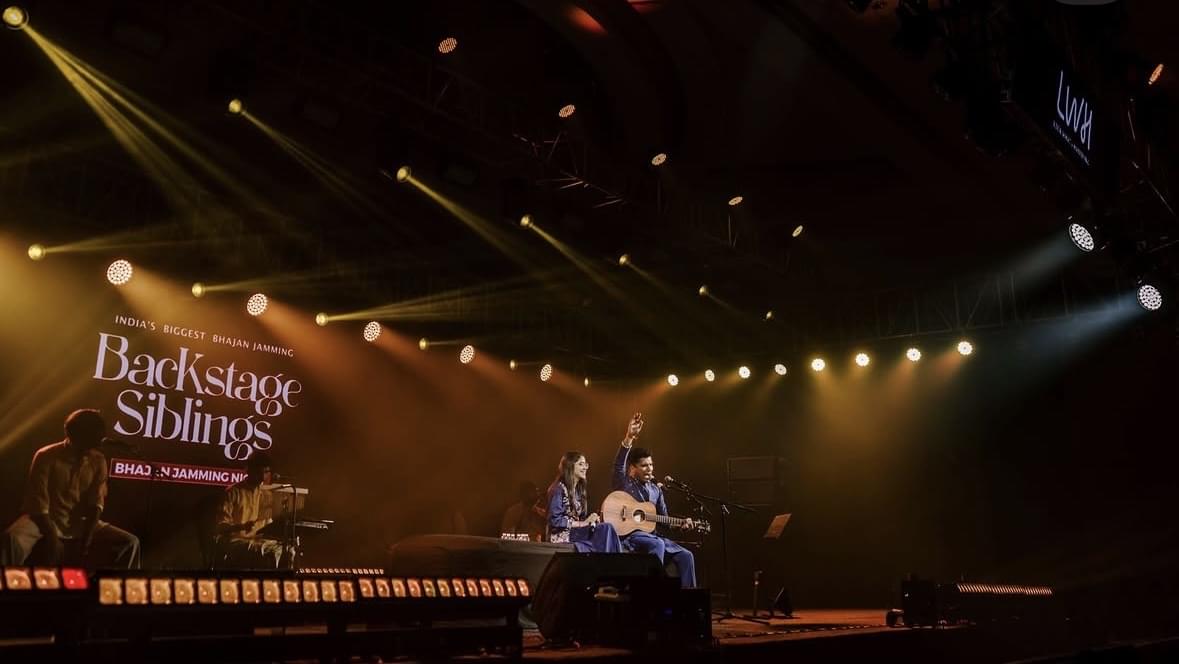
Nagpur had never hosted a bhajan jamming night, and plenty of people doubted one could fill a room. Six months of patient build later, Backstage Siblings, the three Agrawal siblings who give bhajans a modern, Gen-Z touch, played to a sold-out crowd of nearly 2,500, with AllEvents powering the ticketing and on-ground operations. An open jamming session pulled the audience up on stage to lead bhajans of their own, and the night became one giant sing-along, three generations deep, with the line between performer and audience all but gone. People didn’t just watch a show; they became part of it, and walked out already asking when the next one was. This is the story of how a brand-new format won a city over.
The first job wasn’t selling tickets. It was starting conversations.
In the early weeks, the priority wasn’t conversions. It was awareness. For an experience nobody in the city had lived through yet, the first real challenge was simply getting people talking.
AllEvents led the awareness push. Hoardings went up across Nagpur, digital campaigns rolled out, and local communities got pulled in, until word was moving through social circles the way it does when something feels genuinely new. By the time it peaked, AllEvents’ campaigns had reached more than 5 million people across the city. Slowly, the ones who had never heard of Backstage Siblings began asking the right questions. What exactly is bhajan jamming? Why is everyone talking about it? When is it happening? Those questions were the early sparks, the curiosity that always shows up before a crowd does.
About three weeks out, every ticket phase AllEvents had opened, Early Bird, Phase 1, and Phase 2, had sold out. For a first-time event in a city many assumed wouldn’t turn up for something this unfamiliar, that was the moment the doubt started to quiet down. The audience was telling its own story: people will show up for something new, as long as they discover it early enough to fall for it.
As ticket sales climbed on AllEvents, the event stopped being a conversation only among the organisers and the community. It became a topic across the city.
About two weeks before the show, Dainik Bhaskar, one of the region’s leading newspapers, reached out and offered to come on as media partner. Not because of a press release. Not because of a media buy. Because Nagpur was talking too loudly about its first-ever bhajan jamming concert to ignore. It was the kind of unprompted attention you cannot manufacture, the city deciding, on its own, that this mattered.
In its coverage, Dainik Bhaskar called the evening a “Bhajan Jamming Night” where the city came alive through music, and put the spotlight on the people in the room rather than just the act on stage. Reading it afterwards felt like watching the night through the eyes of someone in the crowd. The music, the energy, the sense of togetherness, all of it came through.
By then, something had shifted. People weren’t buying tickets only because they knew the act. They were curious about the experience itself.
More than an audience, a community.
On June 7, 2026, the anticipation finally turned into a real night. Six months earlier, there had been honest doubt about whether a bhajan jamming experience could pull a large crowd in Nagpur. By the time the doors opened, the question had answered itself.
The moment Backstage Siblings took the stage, the room changed. What made the evening land wasn’t only the music. It was the participation. The siblings moved from devotional standards like “Ram Aayenge,” “Govind Bolo,” and “Hari Om Namo” into singalong favourites like “Tum Prem Ho, Tum Preet Ho” and “Damadam Mast Qalandar.” Whole sections of the audience sang along, clapped in rhythm, and gave themselves over to it. For many people there, this was their first taste of bhajan jamming, and yet it felt instantly familiar. Instead of watching, they became part of the performance.
The act: Backstage Siblings
Backstage Siblings are siblings Prapti, Raghav, and Sahil Agrawal, a trio that gives familiar bhajans a modern, Gen-Z touch. The result feels less like a concert and more like a whole room singing as one: devotional melodies reworked with a contemporary sound, an easy call-and-response, and a crowd that carries the tune as much as the stage does. It is a sound built to pull in a 20-year-old and their grandparent at the same time.
The night’s centrepiece made that blurring literal. An open bhajan jamming session invited anyone in the crowd to step up to the mic and lead a bhajan in their own style, and plenty of people did. Strangers took the stage, the room became the choir, and for long stretches it was genuinely hard to tell who was performing and who was watching.
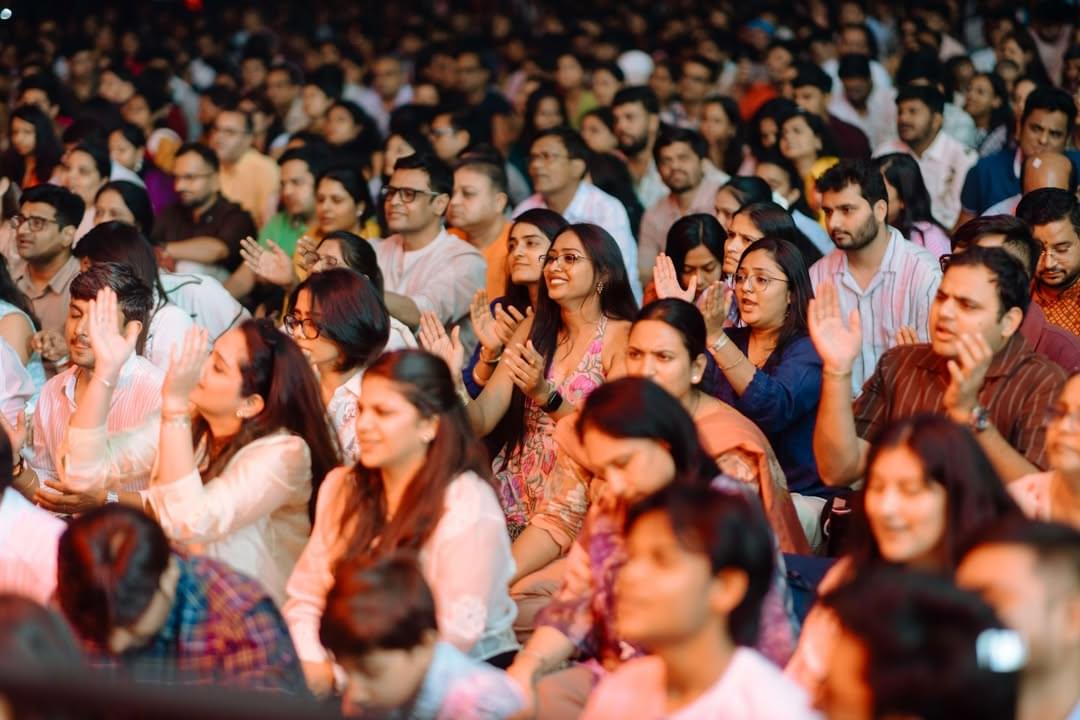
For a few hours, one of Nagpur’s largest venues felt less like a concert and more like a collective celebration. People of different ages, backgrounds, and communities found themselves inside the same shared moment, and the line between performer and audience quietly dissolved. For a city that rarely makes the shortlist, Nagpur’s calendar suddenly looked a lot more alive than the doubters had assumed.
One detail was impossible to miss. At a lot of big events now, you watch crowds spend half the night behind their phone screens. This crowd captured moments, sure, but they stayed present, more in the room than in their camera roll. Plenty of people had also brought their parents and grandparents along. Across the venue, three generations sat side by side, singing the same songs and sharing the same evening. It was the kind of night families had been quietly wanting without quite knowing it existed.
The smaller touches did their part too. There was dedicated seating for senior citizens, pregnant women, and differently-abled attendees, so they could enjoy the night without any added hassle. The food and hospitality drew steady praise through the evening. Details like these can look minor on their own, but together they shape how people remember an event long after the last song.
Behind the scenes, where the night is actually won.
There’s the night the audience experiences, and then there’s the one happening just out of view. Months of planning come down to a few hours, and that is where the real pressure sits.
The show was brought to Nagpur by LWH, a long-time AllEvents partner who believed a bhajan jamming night could work in the city long before the ticket counter agreed. LWH owned the vision and the ground game; AllEvents brought the reach, the ticketing engine, and the on-ground operations that turned the idea into a sold-out night.
A sold-out night is exhilarating, but it is also demanding. Gates have to keep moving. Attendee questions need answers right away. VIPs and special guests arrive with last-minute requests. Volunteers need coordinating, sponsors need looking after, and every team on the ground is racing the clock so the audience never feels any of it. The hardest part is unpredictability. Hundreds of people can land in the same ten-minute window, network connectivity can buckle under the load, and the trickiest moments tend to surface exactly when the venue is fullest.
For Backstage Siblings in Nagpur, the aim wasn’t just getting people through the gates. It was making sure the experience started the second they arrived, and that is where AllEvents did the heavy lifting. AllEvents ran the ticketing in clean phases. Its offline scanning kept check-ins moving even when connectivity wavered. Real-time attendee management gave the teams a live read on crowd flow, so they could respond before a queue ever became a problem. And an AllEvents support crew stayed on through the evening, helping attendees, coordinating with venue partners, and quietly handling the small fires before they reached anyone’s seat.
None of that was about the absence of challenges. Every large event has them. It was about having the systems and the people in place so the night could feel effortless from the outside. Most attendees never see that work, and that is exactly the point. When people leave talking about the music and the memories instead of the queues, the evening behind the evening did its job.
What the city said back.
By the end of the show, that vanishing line between performer and audience was the whole story. As the final songs rang out, nearly 2,500 people stood together, clapping, singing, and chanting as one. For a few minutes, the entire venue moved to the same rhythm. Nagpur Today captured it too, describing the evening as a celebration across age groups, something the city hadn’t seen before, and a reminder that people still choose experiences over things. Read both pieces back to back and it’s hard not to feel they caught exactly what the night was.
Six months earlier, the whole thing had been a question with no obvious answer. A new format, a city people overlook, a large room to fill. Somewhere between the first hoarding and the last bhajan, that question turned into something the city wanted to claim as its own. Audiences in places like Nagpur are hungry for new formats, new communities, and new reasons to gather. They just needed the chance to discover this one.
The strongest sign of that came after the music stopped. Long past the final song, the conversations drifting out of the venue weren’t about any single moment on stage. They were about one thing: when does Nagpur get to do this again.
Ticketing & Marketing partner: AllEvents
AllEvents powered the night end to end, from phased ticketing to offline check-ins, real-time attendee management, and live on-ground support. The result was the best kind of invisible: the organisers got to pour their energy into the experience, and the only thing the crowd had to think about was the music. From the first ticket to the final bhajan, the tech simply got out of the way.
Promote Your Event
Written by
Shital Bapna
Shital works in B2B marketing at AllEvents, focusing on organizer communication and product marketing. She helps create content that explains how AllEvents can simplify event planning and ticketing. In this blog, she introduces AllEvents newly launched recurring slot booking feature for organizers who host events more than once.
View all posts