
The Hidden Fee Era Is Finally Ending.

By Amit Panchal, CEO and Co-founder, AllEvents
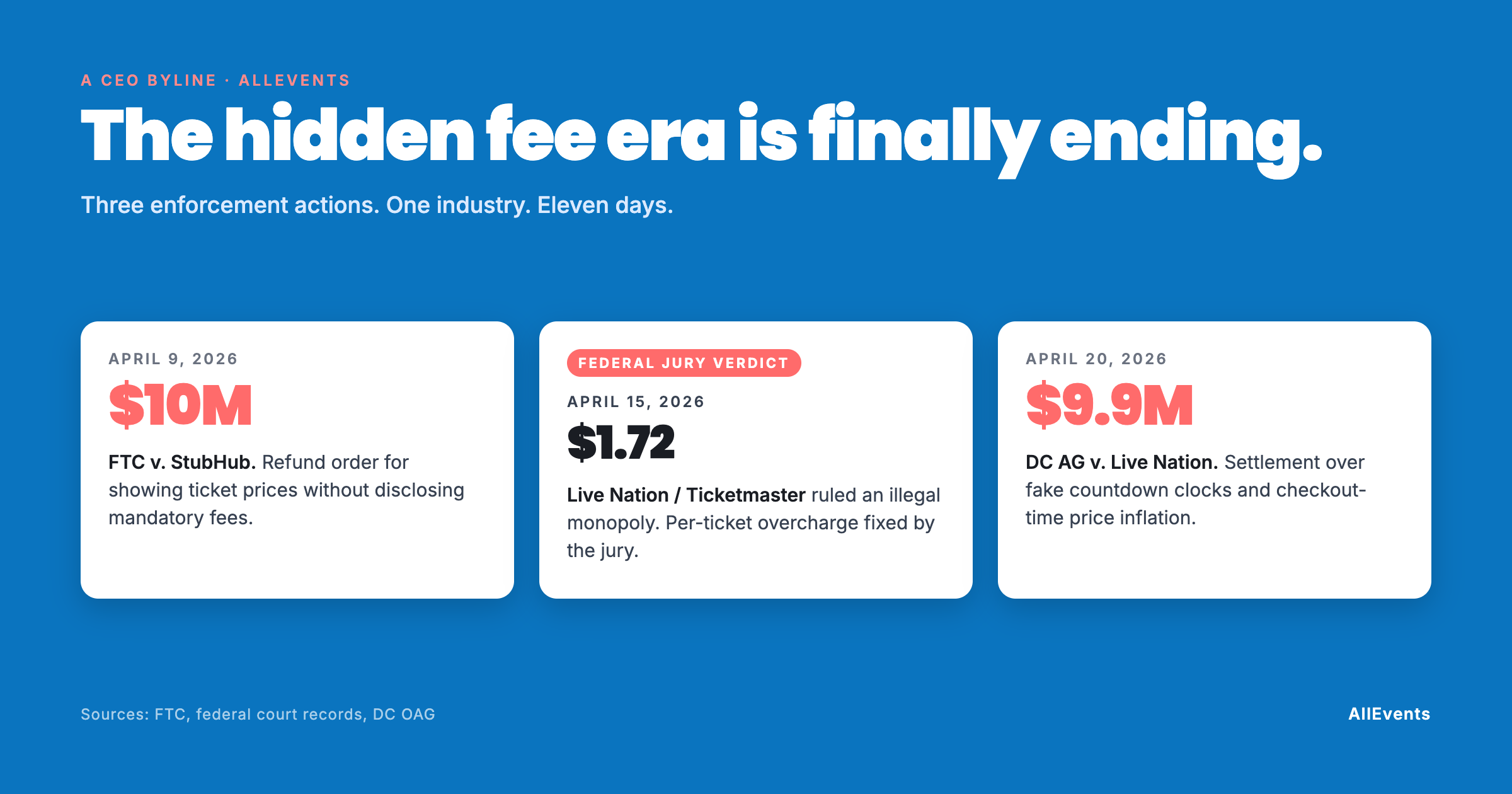
In eleven days this April, three different governments told the live ticketing industry roughly the same thing: hidden ticket fees are over. The FTC fined StubHub $10 million. A federal jury called Live Nation an illegal monopoly. DC’s Attorney General settled with Live Nation for $9.9 million. None of it is a coincidence. Pearl Jam saw most of this coming in 1994.
Three things happened in eleven days
The FTC told StubHub to refund $10 million for hidden ticket fees. A federal jury called Live Nation an illegal monopoly. DC’s Attorney General settled with Live Nation for $9.9 million over what may be the most honest two-word phrase in modern commerce: “fake countdown clocks.”
That’s three different governments telling roughly the same industry roughly the same thing in roughly the same week.
This isn’t a coincidence. It’s also not the start of the story, just the loudest chapter so far. Pearl Jam said most of it to a Congressional subcommittee in 1994, got politely thanked, and then watched the band’s summer tour die in protest while nothing changed. The fee era didn’t just outlive that hearing. It outlived three presidential administrations, two consent decrees, one Bruce Springsteen pricing scandal, the entire Eras Tour meltdown, and every regulator who ever tried to do something about it before eventually losing interest.
So yes, three strikes in eleven days. But before we celebrate, it’s worth asking why this took three decades and what actually had to break for it to happen now.
A 30-year flinch
Here’s the short version of how we got here, told through the people who tried to stop it.
1994. Pearl Jam, then the biggest band in America, decides it wants to play summer shows where tickets cost $18 and service fees stay under $1.80. Ticketmaster says no. It needs at least $2 in fees, thanks. Pearl Jam testifies before Congress on June 30, alleging Ticketmaster’s 1991 acquisition of Ticketron created a monopoly. The DOJ opens an investigation. In 1995, the DOJ closes it, citing “case-making concerns,” which is government for we don’t think we’d win. The “Pearl Jam bill” requiring fee disclosures on tickets dies in committee. Pearl Jam cancels the tour.
2010. Live Nation and Ticketmaster merge. The DOJ approves it, attaches a consent decree, and calls it a day.
2020. The DOJ extends that consent decree for another decade after Live Nation is found to have violated it. The Antitrust Division calls this a “remedy.” Reasonable people disagree.
July 2022. Bruce Springsteen’s tour goes on sale. Some mid-range floor seats hit $4,000 to $5,000 under “dynamic pricing.” The algorithm decides what your ticket is worth based on what you’ll pay, which is a polite way to describe surge pricing for the human experience. Springsteen himself doesn’t address it for weeks. His manager defends it. The story moves on.
November 2022. The Eras Tour presale breaks Ticketmaster so thoroughly the Senate holds a hearing about it. Average all-in fees on those tickets run 20-30% over face value, which means the $499 face-value floor seat actually costs about $620, roughly the price of dinner with whichever friend didn’t get the presale code. The hearing produces strong words. Nothing structural changes.
May 2024. The DOJ refiles. April 15, 2026. A jury hands down the verdict and puts a number on the harm: $1.72 of overcharge per ticket.
The pattern is consistent. A high-profile artist or a fan-rage moment exposes the practice. Hearings happen. Statements get issued. The market structure stays exactly the same. The fees keep growing.
What changed in 2026 isn’t the artist outrage cycle. That’s been continuous since the Pearl Jam testimony was on the front page. What changed is that the regulatory and judicial branches finally moved in the same week.
How $45 turns into $73 (and other magic tricks)
You search for tickets to a show. The price is $45. You click through. You pick the seats. You imagine the night out, draft the text to the friend you’re bringing, plan parking. You get to checkout. The price is now $73.
The difference is a “service fee,” a “facility charge,” a “delivery fee,” and sometimes a fee just called “order processing,” a name so circular it might as well say “fee fee.”
You’ve already invested ten minutes choosing seats. You’ve already committed emotionally. You pay.
That’s not a bug. That’s the design. It’s deliberate friction that works precisely because it shows up late, when you’re already in.

Across the live ticketing industry, this gap averages 27% of face value. On peak tours, it’s been measured closer to 40%. A 2018 GAO study put a number on what most concert-goers had been muttering for years.
The Eras Tour’s $49 lower-bowl seats? Closer to $62 by checkout. The $449 floor seats? Closer to $570 once the stack landed. None of which is illegal, exactly. It’s just engineered. The price the platform shows you is one of those numbers; the price you pay is another; the platform is fluent in the gap between them.
Then on May 12, 2025, the FTC’s Rule on Unfair or Deceptive Fees took effect. It said the all-in price has to be the first price you see, with civil penalties up to $53,088 per violation.
The April 9 StubHub order is what happens when an industry keeps doing the thing the new rule was specifically written to stop. A decade of getting away with it doesn’t end when the rule takes effect. It ends when the bills come.
Why the bet worked for thirty years
A practice this disliked, this widely covered, this consistently litigated, doesn’t survive three decades by accident. It survives because the conditions reward it.
Three things kept the bet alive.
Information asymmetry. Until you reached checkout, you didn’t know the price. There was no “compare carts across platforms” tab. Comparison wasn’t possible because the fees were specifically built to be invisible until you couldn’t easily walk away.
Sunk cost. Ten minutes choosing seats is enough emotional commitment to push most buyers through, even when the price jumps 50%. The platforms knew this. Their checkout flows were designed around it. (Ask anyone in product: a fee shown on the search page converts at one rate. A fee shown after seat selection converts at a much higher rate. The platforms knew this for the same reason airlines knew it for bags.)
No comparison shopping. This is the structural one. The DOJ’s case alleged Live Nation held exclusive primary-ticketing contracts with more than 265 major venues, controlled around 80% of the major-venue ticketing market, and used venue-management firms like Oak View Group as intermediaries to push more venues into exclusive deals. When most of the major shows in your city run through one platform, “I’ll just buy somewhere cheaper” isn’t actually a choice you have.
The first two are buyer psychology. Transparency rules can address them. That’s exactly what the FTC junk fee rule did, and what New York, Connecticut, Maryland, Tennessee, California, Colorado, and Minnesota had already done at the state level before the federal rule landed.
The third one is market structure. No transparency rule fixes it.
That’s why the antitrust verdict matters more than the fines. The fines fix what you see. The verdict targets why it happens.
What the trial actually proved
The April 15 verdict is being summarized as “Live Nation is a monopoly.” It’s worth being more specific.
The jury didn’t just accept market-share statistics. The damning stuff was the internal communications. Emails between the Live Nation CEO and the head of Oak View Group appeared to show Oak View functioning as an enforcer that pushed its managed venues into exclusive Ticketmaster deals to avoid competing with Live Nation directly. The DOJ’s filing argued that Ticketmaster often didn’t need to issue explicit threats anymore, because its “reputation and history of retaliation” were so well-known that venues self-selected into compliance.
The case now heads into a remedy phase. A judge will decide whether Ticketmaster gets structurally separated from Live Nation, whether the court accepts behavioral conditions, or both. Structural remedies, the kind that produced the AT&T breakup in 1984 and that the DOJ tried (and didn’t get) in the Microsoft case in 2001, are seriously on the table for the first time in this lineage.
The trust math nobody is calculating
The settlements coming out of April will produce refunds. Narrow eligibility windows, modest checks. The $9.9 million DC settlement returns up to $8.9 million to consumers. The $10 million StubHub order does the same.
That math misses the larger one.
If the average fee on a live ticket runs 27% above face value, and a typical concert-going household buys two to four tickets a year, the cumulative friction over a decade isn’t measured in refund checks. It’s measured in the decisions buyers stopped making.
Every time someone clicks through to find a $45 ticket has become a $73 ticket, they don’t just get angry at the platform. They get angry at going out. They carry that friction into the next decision. They start staying home a little more. They start calling concerts “too expensive” when what they mean is “the price kept changing on me.” They start subtly redrawing what they consider their own life.
The events industry runs on trust. On the simple feeling that showing up somewhere is worth it before you arrive. Hidden fees corrode that feeling in ways that are hard to measure but real, and the corrosion is paid for by every venue, every promoter, every independent organizer who never saw a cent of the fee and never had a say in how it was charged. Even when the platform took the cut.
That’s the externality the FTC is just now starting to price in. And it’s been compounding for thirty years.
What this means for independent organizers
If you run events for a living, this part is for you. And the first thing worth saying is that the choice to list on a major platform was never naive. For most organizers, for most of the past decade, it was the rational call. That’s where the buyers were. That’s where the search engines pointed. The arithmetic of distribution genuinely worked, and it took real courage to question it from inside the industry. The April news doesn’t make that decision look bad in retrospect. It just makes the next decision more important.
Because the verdict doesn’t change what’s on your stage next weekend. The remedy phase could take a year, maybe two. The state laws, the federal rule, and the antitrust ruling will reshape how the major platforms have to display prices and structure venue contracts. They will not reshape whether you, the organizer, own your audience.
That’s the more important question now. Always was.
For years, the trade was simple: you listed on a major platform because that’s where the buyers were. The platform took its cut, kept your audience data, controlled your direct line to your own fans, and you built your event on rented land. (A phrase every founder has heard about social media platforms and somehow still failed to apply to ticketing.)
That trade is harder to defend now than it was three months ago. The enforcement environment, the public sentiment, and the structural questions about Live Nation’s future are all moving in the same direction. The next twelve months will sort organizers into two groups: the ones still treating distribution as a single point of failure, and the ones quietly diversifying it.
So here’s the work, plainly: own your contact list. Own your payment processor. Own your audience graph. Build channels you don’t lose access to if a platform changes terms, gets broken up, or simply decides your event no longer fits its monetization model. Pick a ticketing setup where the price your buyer sees is the price your buyer pays. Look at how AllEvents does it; look at others. The point is the principle, not the platform. None of this is exciting. All of it is what survives.
What a transparent model looks like in practice
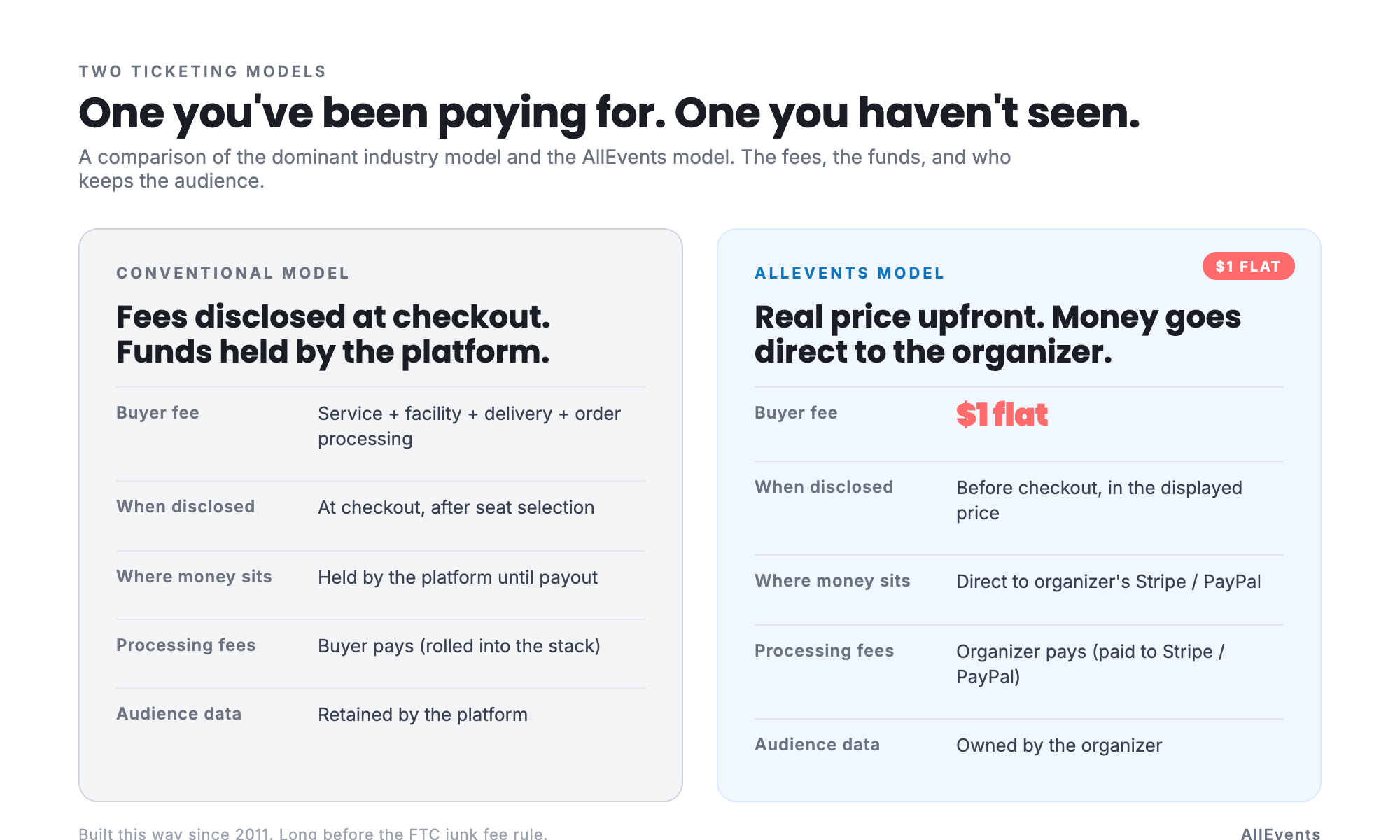
Since people will reasonably ask what the alternative looks like in operation, here’s the version we run at AllEvents, for whatever it’s worth as one example. One dollar per ticket, flat, charged to the buyer. No service fee, no facility charge, no order processing on top. No “fee fee.”
Organizers connect their own Stripe or PayPal account, so the money flows directly from the buyer to the organizer. The organizer covers Stripe or PayPal’s processing themselves. We don’t touch it. What AllEvents takes is the dollar it costs to deliver a digital ticket. That’s the whole take.
What that means in practice: the organizer keeps their margin, their audience data, and the direct line to the buyer. The buyer sees the real price before they’re anywhere near a checkout tunnel. There’s nothing to hide because there’s nothing hidden.
It isn’t the only model that could work this way. A handful of smaller platforms run flat-fee or genuine pass-through variants, and the model matters more than whichever brand happens to be running it. What unites them is a simple principle: the price the buyer sees should be the price the buyer pays. The next decade of ticketing will be built around that principle, or it won’t.
We built it this way in 2011, before the FTC junk fee rule and the state laws and the verdict. Not because we were prescient. Because it’s the only model that makes sense if you actually believe in the product you’re selling.
| Conventional ticketing model | AllEvents model | |
|---|---|---|
| Buyer fee | Service fee + facility charge + delivery fee + order processing | Flat $1 per ticket |
| When fee is disclosed | At checkout, after seat selection | Before checkout, in the displayed price |
| Where money sits | Held by the platform until payout | Direct to organizer’s Stripe or PayPal |
| Who pays processing fees | Buyer (rolled into the fee stack) | Organizer (paid directly to Stripe/PayPal) |
| Audience data | Retained by the platform | Owned by the organizer |
The candor gap
In March, Jack Groetzinger, the CEO of SeatGeek, published an op-ed calling the DOJ’s earlier consent decree “a press release, not a remedy.” The April 15 jury verdict essentially confirmed it. Sixteen years of decrees, two extensions, and Live Nation still controlled the majority of major amphitheaters at the time of trial.
Worth noting: Groetzinger said this before the verdict landed. It’s easy to call incumbents broken after a jury does. It’s a different thing entirely to say it on the record while the outcome is still uncertain and the incumbent in question controls how 80% of your business reaches its audience.
The events industry has had thirty years to develop that habit. It hasn’t. Pearl Jam said it in 1994 and lost. Springsteen wouldn’t address his own ticket prices in 2022; his manager handled it. Most artists won’t, because most artists’ tour economics still flow through the very platforms in question. The independent organizers, the smaller venues, the promoters who would have the most to gain from honest industry conversation are also the ones with the least leverage to start it.
The result is an industry with a lot of press releases and very few honest post-mortems. Three enforcement actions in eleven days is what eventually happens when a market goes that long without one.
Good that it’s ending
The settlements will produce refunds. Narrow windows, modest checks. Most of the buyers have already forgotten the specific transaction.
What they haven’t forgotten is the feeling of being surprised at checkout. The pause. The mental subtraction. The small, accumulating decision that maybe they don’t need this concert after all.
That feeling is the real cost. It’s been accumulating for thirty years.
If you’re running events, do one thing this week: pull your audience data into a list you control, and look at one ticketing setup where the price your buyer sees is the price your buyer pays. Start with how AllEvents handles it, or start somewhere else. The point is to start.
And if you’re heading to a show this weekend, may the price you see at search be the price you pay at checkout. That used to be too much to ask. As of last week, it’s the law.
Good that it’s ending.
Frequently asked questions
What are hidden ticket fees?
Hidden ticket fees are mandatory charges that ticketing platforms add at checkout after displaying a lower base price upfront. They typically appear as a service fee, facility charge, delivery fee, or order processing fee. Across the live ticketing industry, they average 27% of face value, sometimes climbing closer to 40% on peak tours. The FTC’s Rule on Unfair or Deceptive Fees, in effect since May 12, 2025, requires platforms to disclose the total price upfront.
What did the April 15 Live Nation monopoly verdict decide?
A federal jury in New York found Live Nation and Ticketmaster liable on every monopolization count brought by the Department of Justice and 30 state and district attorneys general. Evidence included internal communications appearing to show Live Nation using venue-management intermediaries to push exclusive Ticketmaster deals, with the DOJ arguing the company’s “reputation and history of retaliation” did the rest. The case now moves into a remedy phase, where the court will decide between structural separation, behavioral conditions, or both.
Why did the FTC fine StubHub $10 million?
On April 9, 2026, the FTC ordered StubHub to refund $10 million for showing ticket prices that did not include mandatory fees, in violation of the FTC Act and the FTC Rule on Unfair or Deceptive Fees. The conduct continued after the rule had already taken effect. The FTC can pursue civil penalties of up to $53,088 per violation. The settlement was the first major enforcement action of its kind under the new rule.
Which states had ticket fee transparency laws before the federal rule?
By the time the FTC junk fee rule took effect in May 2025, California, Colorado, Connecticut, Maryland, Minnesota, New York, and Tennessee had already passed their own fee transparency statutes. The federal rule made coverage uniform nationwide, but the patchwork of state laws established that the regulatory direction was clear well before the FTC acted.
Are there ticketing platforms without hidden fees?
Yes. AllEvents charges a flat $1 per ticket with no service fee, facility charge, or order processing fee. Organizers connect their own Stripe or PayPal account, payments flow directly from buyer to organizer, and the buyer sees the full price before checkout. AllEvents has operated this model since the company was founded in 2011.
