Easter Event Marketing: 5 Trends to Fill Every Seat in 2026
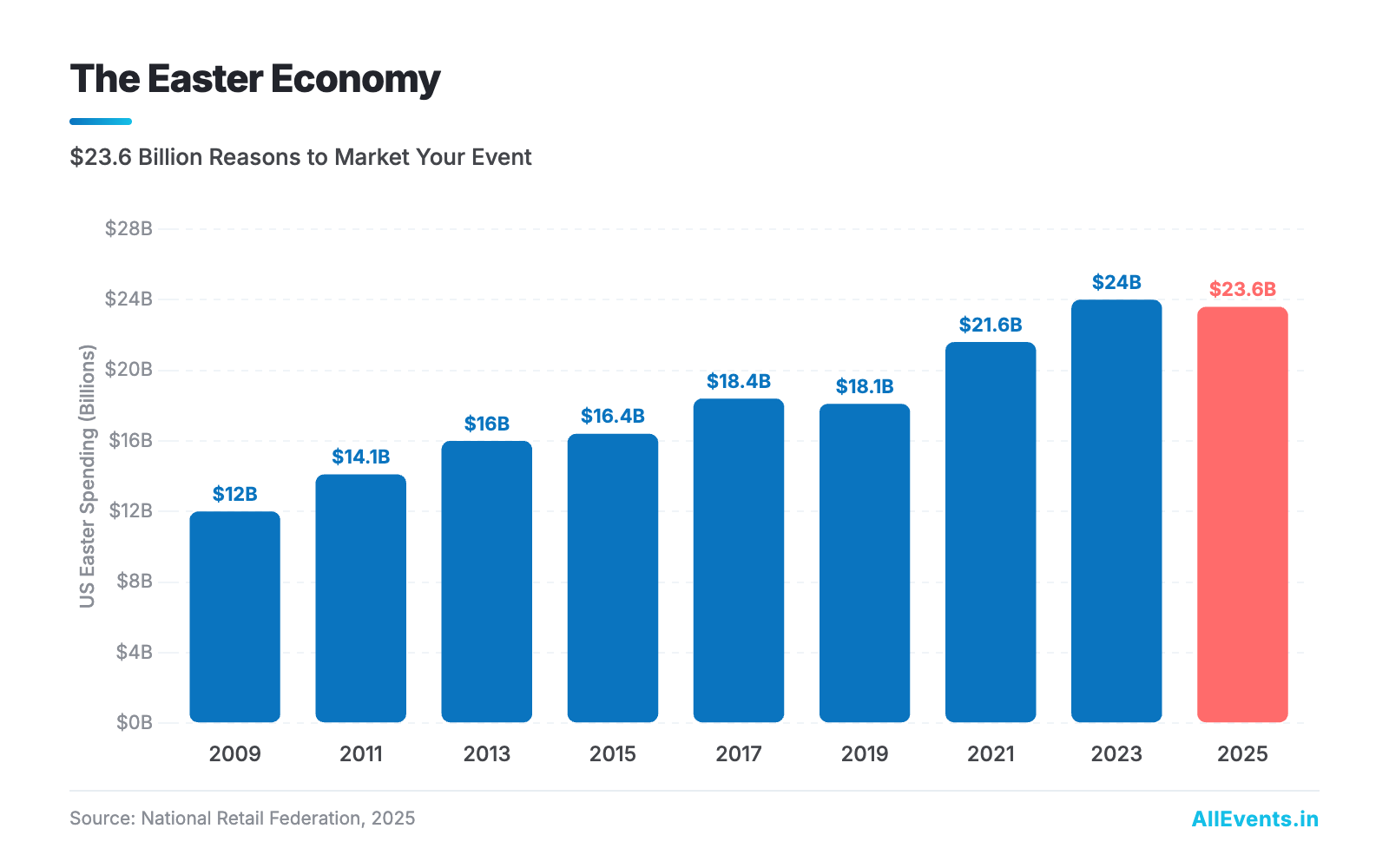
Americans will spend $23.6 billion on Easter this year. Most of it goes to candy, ham, and pastel-colored plastic eggs.
Very little of it goes toward events. That gap is the opportunity.
Easter is one of the most widely celebrated holidays in the United States. About 79% of Americans mark it in some way, according to the National Retail Federation. And while the candy and grocery industries have had their Easter marketing figured out for decades, the event side of the holiday remains one of the most under-served opportunities in the spring calendar.
Families and friend groups hunting for something to do this Easter are already searching. The question is whether your event shows up when they do.
Easter isn’t hard to market. Most organizers just start too late and try too hard.
The trends and data tell a clear story about how Easter event marketing is shifting in 2026. Here’s what to actually do about it before April 5.
What Is Easter Event Marketing?
Easter event marketing is the practice of promoting events (egg hunts, brunches, community fairs, family festivals, and seasonal experiences) to reach the right audience in the weeks leading up to Easter Sunday. Unlike year-round event promotion, Easter marketing operates on a compressed two-week window when consumer intent peaks and buying decisions get made fast.
Done well, it turns a $23.6 billion consumer spending moment into a sold-out event. Done late, it turns a great event into an empty room.
This guide covers the five trends reshaping how to promote Easter events in the USA in 2026, plus a day-by-day sprint plan for organizers with Easter 2026 (April 5) on the calendar.
The Easter Opportunity Is Bigger (And More Competitive) Than You Think
Easter spending has nearly doubled over the last 15 years. In 2009, Americans spent around $12 billion on the holiday. By 2025, that number had climbed to $23.6 billion (NRF), and it’s on track to hold steady or grow again in 2026.
The bulk of that spending is still on food and candy. But the slice going toward experiences and events is growing. Families are increasingly booking Easter brunches, egg hunts with actual craft vendors, spring festivals, and community markets rather than staying home with a basket of chocolate. They want something to do.
That shift creates real opportunity for organizers.
The competition has gotten smarter, too. More local organizers are running Easter events than ever: egg hunts, brunch pop-ups, Easter markets, family fairs, sunrise community gatherings. For attendees, that means more options. For organizers, that means a louder room to stand out in.
The organizers who win are not the ones with the biggest budgets. They’re the ones who understand where attention goes in the two weeks before Easter Sunday, and they show up there early.
Searches for “Easter events near me” and “things to do for Easter” spike sharply in the 10-14 days before the holiday, then drop off quickly as families commit to plans and stop looking. Organizers who have their events fully listed by the Monday two weeks before Easter consistently outperform those who scramble in the final days. This year, that window is March 22-24. Today is not too late. But every day of delay is a day closer to missing the peak.
Trend 1: Micro-Experiences Are Beating Mass Events
For years, the default assumption in Easter event planning was scale. More attendees meant more revenue. Bigger meant better.
That assumption is getting quietly dismantled.
The 2026 event industry has swung hard toward what researchers and organizers are calling micro-events: smaller, curated, intentional gatherings designed for a specific audience rather than everyone at once. According to the Eventex 2026 Trends Report, community building is the second most important event trend of the year. Event organizers are moving away from building audiences and toward nurturing smaller, tighter communities with recurring touchpoints.
Easter is one of the most naturally suited holidays to this format.
An egg hunt for 50 families feels special. It feels like it was designed for you. An egg hunt for 500 families feels like a parking lot situation.
The best Easter event ideas in 2026 are not just “Easter events.” They’re specific. An artisan Easter market with local vendors at a craft brewery. A sunrise yoga session followed by a catered brunch in a garden venue. An Easter Sunday family 5K with a post-race egg scramble for kids. A high-tea Easter brunch in a boutique hotel with exactly 40 seats.
Specificity is not a constraint. It’s a marketing advantage. When your event has a clear audience and a clear identity, your description writes itself, your ad targeting gets sharper, and word-of-mouth travels further.
It also helps with discovery. “Easter egg hunt in Wicker Park” performs better in local search than “Easter Event.” “Vegan Easter Brunch in Austin” finds the people it’s for. Generic titles are invisible.
Own a niche. Go smaller on audience, higher on specificity. The sold-out Easter events this year will not be the ones that tried to please everyone.
The most successful Easter event marketing starts with specificity. A clearly defined event for a clearly defined audience performs better in search, social, word-of-mouth, and email than a generic “Easter event” at every level.
Trend 2: Discovery Timing Is Everything (And You’re Probably Starting Too Late)
There is a moment each spring when Easter searches hit their peak. It’s not Easter week.
It’s two weeks before.
About one in three Americans starts planning for Easter several weeks out, and search interest for local Easter events and activities peaks in the 10-14 days before Easter Sunday. After that, it drops sharply as families commit to their plans and stop looking.
This year, that window opened this week.
If your event is not fully visible across your discovery channels right now, you’re already behind the peak. Not panicking-behind. But behind enough that every day of delay costs you attendees.
How to Promote Your Easter Event: The 2-Week Sprint
Here’s exactly what to do, and when:
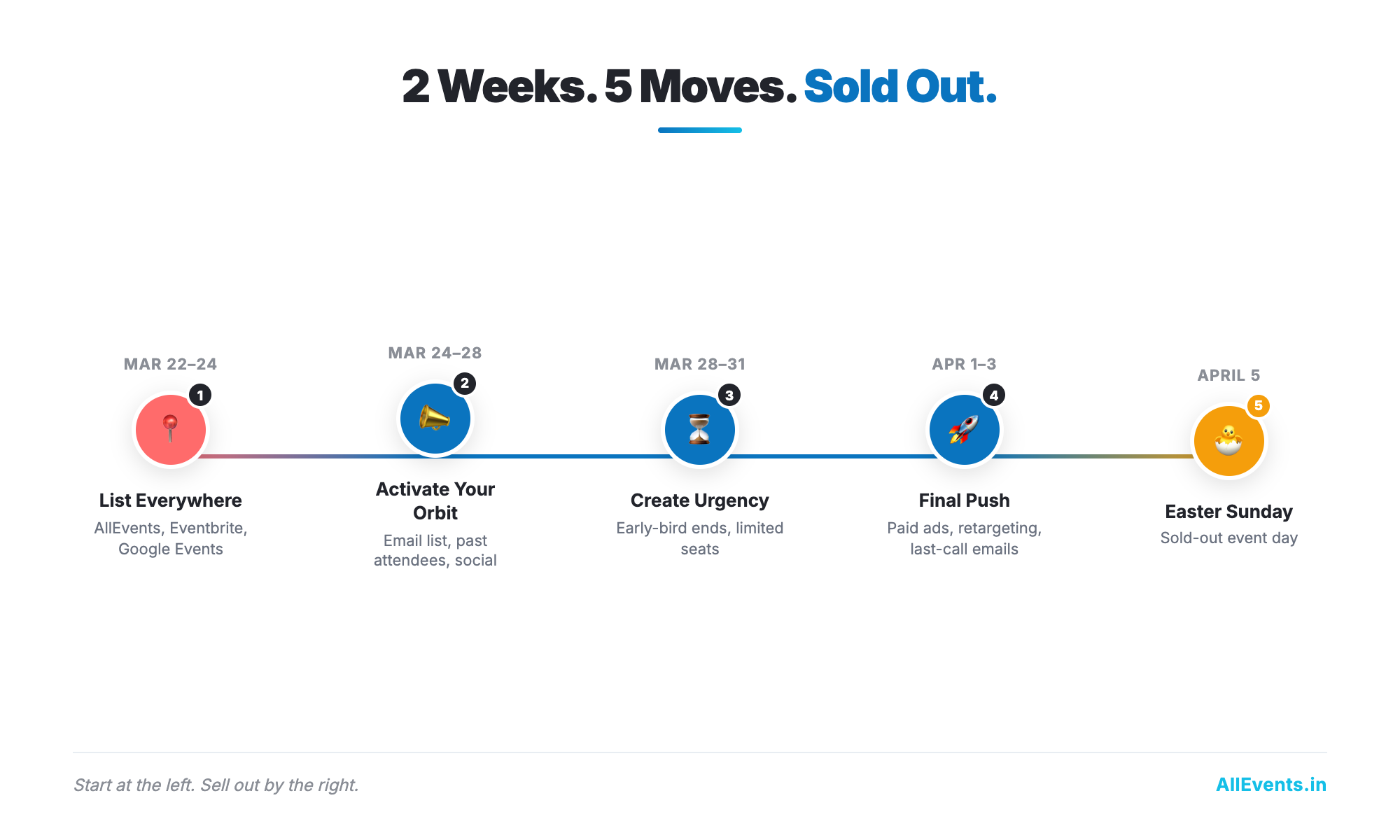
- March 22-24: List everywhereGet your event fully listed on every discovery platform. AllEvents, Facebook Events, Eventbrite if you use it. “Fully listed” means a complete description, real photos or graphics, ticket link live, and accurate location and timing. Partial listings don’t get discovered. They get skipped.
- March 24-28: Activate your orbitSend your email announcement to past attendees with early bird pricing. Post your launch content on social. This week is about activating the people already in your orbit.
- March 28-31: Create urgencyEnd early bird pricing with a “last 48 hours” email. Post social proof content (ticket count, who’s coming, behind-the-scenes glimpses). Fence-sitters need to feel movement before they commit.
- April 1-3: Final pushCountdown email to anyone who opened previous emails but didn’t buy. Last-chance social content. The energy should shift from “here’s what we’re doing” to “this is almost full.”
- April 5: Easter SundayDay-of content. Welcome the crowd. Activate your hashtag. Give attendees something worth sharing.
Get your event on AllEvents before March 24. With 20M+ monthly users actively discovering events, the platform’s discovery feeds reward complete listings. The more detail you provide, the better your visibility in “Easter events near me” searches across your city. It’s free to list and takes less time than one email draft.
The most expensive Easter marketing mistake is not a bad ad. It’s a good event that nobody finds out about in time.
Trend 3: Community and Social Proof Close the Sale
People do not decide to attend Easter events based on event descriptions.
They decide based on who else is going.
The dominant 2026 event marketing trend is community over audience. The industry’s smartest organizers have stopped trying to broadcast their events to strangers and started building visible communities of confirmed attendees that new people want to join.
Easter is an ideal occasion for this because the holiday is already community-coded. It’s family, friends, neighbors. Content showing real families, real community moments, and actual photos from past events converts far better than polished promotional graphics.
A few tactics that work:
Show Momentum, Not Just the Event
“250 families have already RSVP’d” is more convincing than a flyer. Update your ticket count publicly. Post it on your social. Tell your email list how many people are coming. Scarcity and social proof are different things; showing a real crowd is the latter.
Ask Past Attendees to Show Up Before the Event
A simple Instagram story prompt (“Share your favorite memory from last year’s Easter at [venue]”) does two things: it surfaces authentic content you didn’t have to create, and it signals to new potential attendees that this event has a community around it.
Create a Shareable “I’m Going” Moment
When someone buys a ticket, give them something easy to share: a digital social card, a simple text template, a custom sticker for Instagram stories. Most people will not organically post that they bought a ticket. Make it easy and they will.
Work With 2-3 Local Micro-Influencers
Not mega-influencers. Local parent bloggers, neighborhood food accounts, community lifestyle creators with 10K-50K followers. Their recommendations carry more weight because their audience is your audience. Give each one a unique discount code so you can track conversions.
Consumers consistently rank peer recommendations among their most trusted sources of information. The most effective Easter marketing you can do is not an ad you pay for. It’s the post a happy attendee makes for free.
Social proof is the most underleveraged Easter marketing tool. Publicly showing ticket counts, sharing past attendee content, and building visible momentum converts undecided prospects faster than any paid ad.
Trend 4: Email Still Wins — But Only If You Segment
Social media gets the headlines. Email keeps selling the tickets.
According to Bizzabo’s 2026 Event Marketing Report, email remains the single most effective channel for driving event registrations. It is also, consistently, the most under-used.
Most Easter event organizers send one email to their whole list. One. Before the event.
This is the equivalent of serving everyone at a dinner party the same dish, regardless of what they actually want to eat. Technically you fed everyone. In practice, half of them didn’t eat.
The 3-Segment Easter Email Strategy
These are your warmest prospects. They know your event, they’ve been before, and they came back for a reason. Don’t send them a generic “you’re invited.” Send them a re-invite that acknowledges they’ve been before. “You came last Easter. This year we’ve added live music and expanded the kids’ zone. Your spot is waiting.”
People who’ve opened your previous emails, clicked on your event page, or RSVP’d to a past event but haven’t bought for this one. They’re not cold. They just need a push. Send them social proof. “300 people are already coming. Tickets are going fast.” Include a countdown. Create urgency.
Cold-ish contacts who’ve joined your list but never attended. For these, the frame is discovery, not loyalty. “Easter is in two weeks. Here’s what’s happening in [city]. You don’t want to miss this one.”
One email to all three groups is noise. Three tailored emails are a conversation.
Early bird pricing combined with a countdown timer is still one of the highest-converting mechanics in event marketing. Start with early bird (creates a purchase incentive), end with a real countdown (creates urgency). Together, they drive significantly higher conversion rates than standard pricing alone.
Subject lines: specificity wins. “Easter Brunch is this Sunday at The Garden” outperforms “Don’t miss our Easter event!” every time. Generic is forgettable. Specific is clickable.
Trend 5: Multi-Platform Discovery (And Why Instagram Alone Won’t Save You)
Instagram and TikTok are where Easter events get discovered. Facebook Events and AllEvents are where tickets actually get sold. Understanding the difference between these two things will save you a lot of wasted energy.
Social media is inspiration. When someone stumbles across a beautiful post about your Easter brunch, they feel something. They save it. They show it to a friend. They think “we should do this.” Then they close the app and forget about it.
Google is intent. When someone searches “Easter events near me” or “Easter egg hunt [city] 2026,” they are actively looking for something to book. That search is worth ten social media saves.
This is where the multi-platform strategy matters.
The Easter Event Promotion Checklist by Platform
| Channel | Role | Actions |
|---|---|---|
| AllEvents | Intent-based discovery | Full listing with photos, description, ticket link by March 22 |
| Facebook Events + Groups | Local community reach (35+ audience) | Create event, share to local parenting and neighborhood groups |
| Instagram + TikTok | Inspiration and awareness | 4 posts: announcement, behind-the-scenes, social proof, last-chance |
| Direct conversion | 3 segmented campaigns: past attendees, engaged non-buyers, new prospects | |
| Paid social ads | Amplification | $50-100 Facebook/Instagram ad targeting local zip codes + “family activities” interest |
For discovery by intent (Google + event platforms): Get fully listed on AllEvents and any relevant event discovery platforms. These are where people search when they’ve already decided they want to do something for Easter. AllEvents is where intent meets discovery. People come specifically to find things to do, which means your conversion rate from an AllEvents listing is significantly higher than a social media post. Free to list. Reaches 20M+ monthly users who are actively looking.
For local community reach (Facebook Events + groups): Facebook is unfashionable and extremely effective for local event promotion among the 35+ audience, which is a significant portion of Easter event attendees (families). Create a Facebook Event, then share it into relevant local groups: neighborhood pages, parenting groups, community boards. This costs nothing.
For paid amplification (Facebook/Instagram ads): Even a $50-100 Facebook ad targeted by zip code and interest in “family activities” or “local events” can meaningfully move tickets for a local Easter event. The cost per ticket click for a well-targeted local event ad can be as low as $2-5.
Instagram creates interest; AllEvents and Facebook Events convert it. Easter event promotion requires both: social media for reach, discovery platforms for the moment when someone is actually ready to commit.
Frequently Asked Questions About Easter Event Marketing
When should I start marketing an Easter event?
Start marketing your Easter event at least two weeks before Easter Sunday. Search interest for “Easter events near me” peaks 10-14 days before the holiday, then drops sharply as families lock in their plans. For Easter 2026 (April 5), the ideal launch window opens March 22-24. Organizers who wait until the week of Easter miss the peak discovery window entirely.
What are the best platforms to promote Easter events?
The most effective Easter event promotion combines multiple channels. Event discovery platforms like AllEvents (free to list, 20M+ monthly users) capture high-intent searches. Facebook Events reach the family audience (35+) through local groups. Instagram and TikTok build awareness and inspiration. Email to past attendees drives the highest conversion rates of any channel.
How do I sell out an Easter event?
To sell out an Easter event: get listed on discovery platforms two weeks before Easter, launch early bird pricing immediately, segment your email list (past attendees, engaged non-buyers, new prospects), build visible social proof by sharing ticket counts publicly, and partner with 2-3 local micro-influencers for authentic community reach. The combination of urgency (early bird) and momentum (social proof) drives the fastest sell-through.
What types of Easter events sell the most tickets?
Specific, niche Easter event ideas consistently outperform generic ones. Micro-experiences (artisan Easter markets, themed brunches, family 5Ks, and intimate egg hunts under 100 attendees) sell out faster than large-scale generic events. Specificity in the event name and description also improves search visibility: “Easter egg hunt in [neighborhood]” ranks better and converts better than “Easter Event.”
How much should I spend on Easter event marketing?
Most local Easter events can generate strong ticket sales with $0-200 in paid promotion. Free channels (a full AllEvents listing, Facebook Event, segmented email, and organic social) drive the majority of sales for community-scale events. For faster results, a $50-100 Facebook or Instagram ad targeted by local zip code and family interest can achieve $2-5 cost per ticket click for well-targeted campaigns.
What is a good Easter event marketing strategy?
An effective Easter event marketing strategy has four components: (1) early listing on discovery platforms before the 2-week window, (2) segmented email campaigns to warm, engaged, and new audiences, (3) community-building social proof that makes potential attendees see others are already going, and (4) a multi-platform presence matching each channel’s role: discovery platforms for intent, social media for inspiration, email for conversion.
Stop Hoping. Start Marketing.
Easter isn’t hard to market. The organizers filling their seats this April are not spending more money than you. They’re not running flashier campaigns. They’re doing three things you can do starting today: getting specific about who their event is for, showing up where intent is highest, and building visible momentum that makes other people want to join.
List Your Easter Event on AllEvents
Free to list. 20M+ monthly users actively searching for things to do. Your event in front of the right people before the discovery window closes.
List Your Event FreeYou have 14 days. That’s enough.
Start at the left. Sell out by the right.